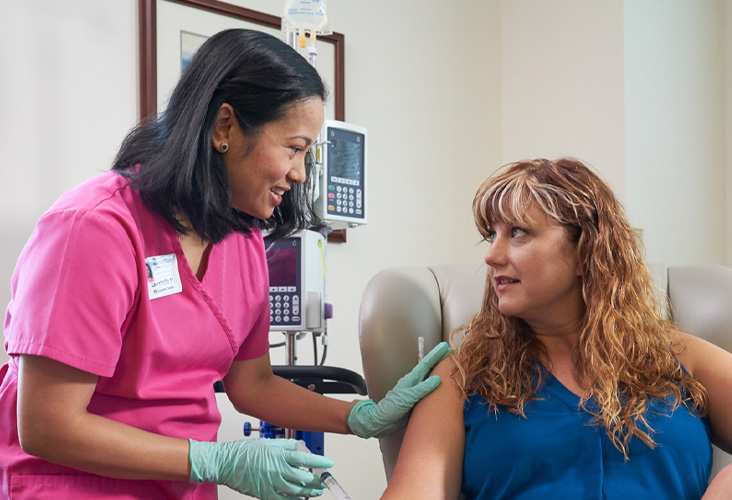
Caring for a friend, relative or loved one with cancer may be both challenging and overwhelming. And the time required to help look after a cancer patient may make it difficult for a caregiver to find the time to care for his or her own health.
That’s why City of Hope Chicago offers a Cancer Screening Program that allows eligible caregivers the opportunity to take advantage of their loved one’s hospital visits to undergo important screenings for breast, colorectal or lung cancer.
The screening program is available to those who meet certain criteria outlined in screening recommendations for breast cancer, lung cancer and colorectal cancer. We’ll check your eligibility and insurance coverage to determine whether you qualify to be screened. In many cases, insurance policies cover much if not all of the cost of screenings for those eligible.
For more information or to schedule a screening call:
Our signature program offers those who qualify for the opportunity to get screened for the cancers below:
City of Hope Chicago uses digital breast tomosynthesis (DBT), also known as 3D mammography, to screen for breast cancer.
For women at average risk, The American College of Radiology and the American College of Surgeons' National Accreditation Program for Breast Centers recommend:
You may also qualify if you have a known genetic mutation, have been diagnosed with a hereditary cancer syndrome or have a family history of breast cancer.
City of Hope Chicago offers lung cancer screening using low-dose computed tomography (CT) scans.
The U.S. Preventive Services Task Force recommends you get screened for lung cancer if you:
*A pack year is the number of packs smoked per day multiplied by the number of years smoked.
City of Hope Chicago offers colorectal cancer screening with a colonoscopy.
The American Cancer Society (ACS) recommends those at average risk for colorectal cancer begin regular screenings at age 45. High-risk patients may also be eligible for screening if they have:
City of Hope Chicago provides comprehensive screening for Barrett’s esophagus, a precancerous condition that can increase a person’s risk of developing esophageal cancer. Barrett’s esophagus, most frequently diagnosed in people who suffer from chronic acid reflux disease, results when acid from the stomach damages the cells inside the esophagus. Our Chicago cancer experts perform minimally invasive Barrett’s esophagus screenings, which usually includes taking a sample of tissue to examine in a lab. They are also highly experienced at creating personalized treatment plans that reduce patients’ risk of esophageal cancer while helping to manage the condition.
Learn more about our Barrett’s esophagus screening program
Delayed screenings may lead to delayed diagnoses. And more advanced cancers are more difficult to treat and may result in poorer outcomes. At the Cancer Screening Program at City of Hope Chicago, we want to help you take care of your own health so you can take care of your loved one.
Cancer screening tests are critical tools to help detect cancer early, before it’s had a chance to grow or spread. At City of Hope Chicago, our specialists and other cancer experts are singularly focused on detecting, diagnosing and treating cancer. Their expertise comes from treating cancer patients every day.
Should screening results indicate the need for a follow-up visit, our board-certified oncologists and other clinicians are trained to determine whether cancer has developed and, if so, to offer treatment options tailored to you and your individual needs and diagnosis.